Innovation & Research

Engineering better energy and infrastructure systems

Bitcoin mining today isn’t won by raw horsepower alone — it’s won by efficiency, discipline, and the willingness to engineer every variable that affects margin.

At Yoonu Leer, we treat mining as an engineering problem first and a financial one second. Every kilowatt of power, every degree of heat pulled out of a container, and every cubic foot of wasted gas represents an opportunity that most operators leave on the table.

Our research and engineering teams work at the intersection of thermal science, energy sourcing, and hardware optimization, applying the same rigour you’d expect from industrial process design to the fast-moving world of digital asset mining.

Innovations driving change

Smarter technologies for cleaner and more efficient flaring.

  • Advanced sensors

    Detect leaks, optimize combustion

  • AI & data analytics

    Predictive maintenance, better decision-making

  • Flare gas recovery systems

    Capture and reuse instead of burning

  • Low-emission flare tips

    Reduce NOx and CO₂

  • Renewable energy solutions

    Powering remote monitoring and control systems

Thermal engineering & cooling

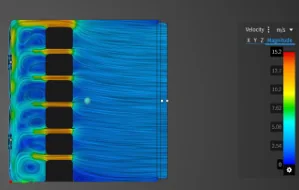
Every container in our fleet is a purpose-built thermal system, not a retrofit. Our ASIC enclosures use Celdek evaporative cooling engineered around the specific heat load, airflow, and ambient humidity profile of each deployment site — validated through CFD simulation before a single unit ships.

Extreme-climate deployments demand more than standard HVAC math. In high-humidity conditions, condensation margins at the cooling pad outlet can narrow to fractions of a degree — a failure mode most cooling vendors don’t model for. We do. Our thermal engineering process includes site-specific environmental risk assessment across environmental risk categories, from seasonal humidity swings to dust loading, ensuring hardware stays within safe operating temperature year-round.

Select a part to see what it does. Air flows from the intake fans, through the heatsinks, to the exhaust fans.

Simplified model at real proportions (about 450 × 219 × 293 mm). The internal layout and chip count are indicative.

Hardware specifications

Model
Bitmain Antminer S21 Pro
Algorithm
SHA-256 (Bitcoin / BTC)
Hashrate
234 TH/s (typical)
Power consumption
3,510 W at the wall (25 °C)
Power efficiency
15 J/TH
AC input voltage
220–277 V AC
AC input current
20 A
AC input frequency
50–60 Hz
Network connection
RJ45 Ethernet 10/100M
Dimensions (L × W × H)
450 × 219 × 293 mm
Net weight
20 kg
Noise
76 dBA at 25 °C
Operating temperature
−20 to 45 °C
Ansys airflow simulation showing velocity streamlines through a cooling array
Ansys: airflow simulations with S21 Pro

Our cooling systems are stress-tested against worst-case seasonal humidity, not just nameplate specs — because a container that only works in dry conditions isn’t ready for deployment.
Energy innovation

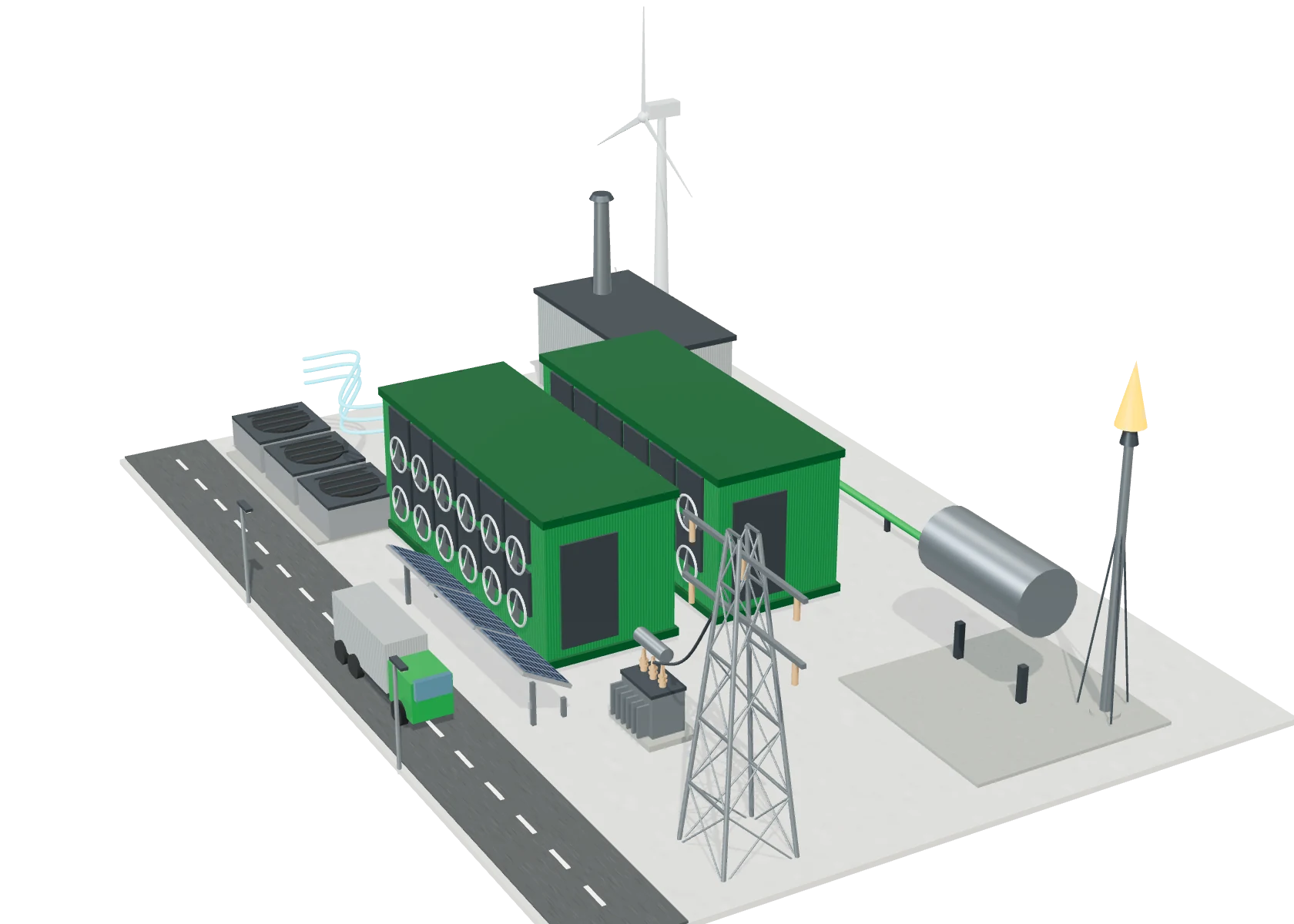
Stranded and wasted energy is our fuel source. Our flare-to-power integration converts otherwise-flared gas into grid-quality electricity, powering mining operations directly at the source — cutting emissions while turning an environmental liability into productive compute.

This approach lets us site mining infrastructure where power is cheapest and most underutilized, rather than competing for capacity on constrained grids.

From flare gas to power
  1. Flared associated gas
  2. Well head
  3. Filter separator
  4. Gas processing
  5. Gas turbine generator
  6. Electricity output
  7. Grid / off-grid power

Gas that would be flared is cleaned, burned in a generator and turned into power for the grid or a Yoonu Leer container. Select a stage to see its equipment: amber lights carry gas, green lights carry power.

The power output lands in a Yoonu Leer container, which turns the electricity into flexible computing load. Discover Yoonu Leer

  • Process-gas synthesis & refinery integration

    Our research focuses on the thermodynamic conversion of complex, variable-composition refinery off-gases into highly stable industrial payloads. Unlike standard upstream wellhead gas, refinery fuel networks experience rapid shifts in gas chemistry due to shifting downstream cracking and hydrotreating cycles. Our innovation lies in engineering adaptive fuel-conditioning skids capable of managing real-time fluctuations in gas density, methane number, and localized hydrogen concentrations.

  • Closed-loop waste heat integration

    True energy innovation extends beyond fuel sourcing into comprehensive thermal optimization. Our engineering layout treats the container network and the gas generation assets as a single thermodynamic system. We actively research the capture and redirection of low-grade jacket water heat and high-temperature exhaust from the gas reciprocating engines.

Hardware & firmware optimization

Efficiency doesn’t stop at the container door — it extends down to individual chips. We continuously evaluate firmware tuning, per-unit voltage and frequency scaling, and adaptive performance monitoring across our fleet, because identical ASIC units rarely perform identically once they’re deployed at scale.

Custom firmware lets us adjust clock speeds in real time based on live profitability data, automatically underclocking during low-revenue periods to protect hardware and conserve power, then ramping back up when conditions justify it. This kind of fleet-wide, data-driven tuning is invisible to anyone walking through the site, but it’s often the difference between an operation that merely survives a difficult market and one that stays profitable through it.

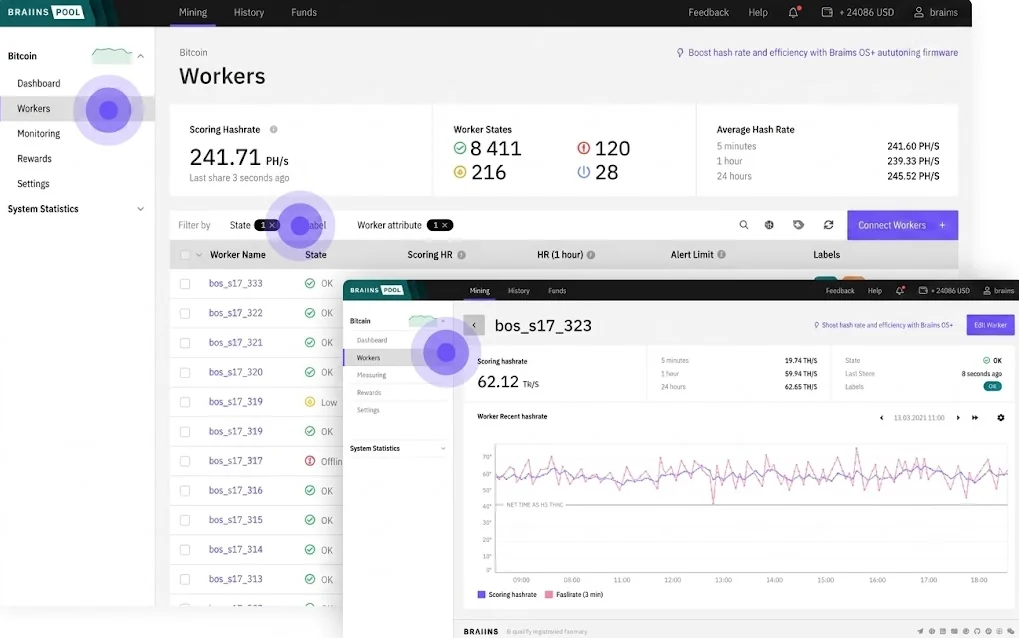
Braiins OS dashboard showing ASIC miner monitoring: worker list, scoring hashrate and a per-worker hashrate chart
Braiins OS dashboard interface — ASIC miner monitoring

The monitoring platform continuously audits real-time metrics including chip temperatures, voltage variances, and individual worker status indicators. Automated alert thresholds trigger instant notifications or autonomous control loops when a unit drifts outside standard operational boundaries.

Rather than relying on reactive maintenance, the system evaluates individual chip health across the fleet through granular hashrate tracking, scoring metrics, and error-rate monitoring. By tracking real-time data against historical averages (5-minute, 1-hour and 24-hour baselines), predictive algorithms flag anomalies in worker hashrate profiles.

The centralized dashboard provides complete visibility across all deployed assets, mapping individual miner metrics to overarching container performance indicators. Detailed worker histories, hashboard hashrate charts, and hardware logs are continuously aggregated.

Emissions assessment & gas utilization

Using otherwise-flared gas for productive power can recover wasted energy. Any emissions benefit requires a site-specific baseline covering methane leakage, combustion performance and the power displaced.

Methane emissions by source
  • Natural gas and petroleum systems32%
  • Enteric fermentation27%
  • Municipal solid waste landfills14%
  • Manure management9%
  • Other sources9%
  • Coal mining6%
  • Other landfills3%

Source: US Environmental Protection Agency (EPA)

Grid interoperability & dynamic load response

Our modular infrastructure acts as a dynamic, controllable load. In grid-tied operations, our software enables sub-30-second load shedding, allowing power producers to reduce mining demand when required during peak consumer demand, balancing frequency and maximizing grid resiliency.

Grid stability: 100% – Balanced
Bitcoin mining balancing a grid with intermittent power generation (source: Digital Mining Solutions)

Have a site or a technical question?

Talk to our engineers about thermal design, gas utilization or grid integration.

Discuss your project